
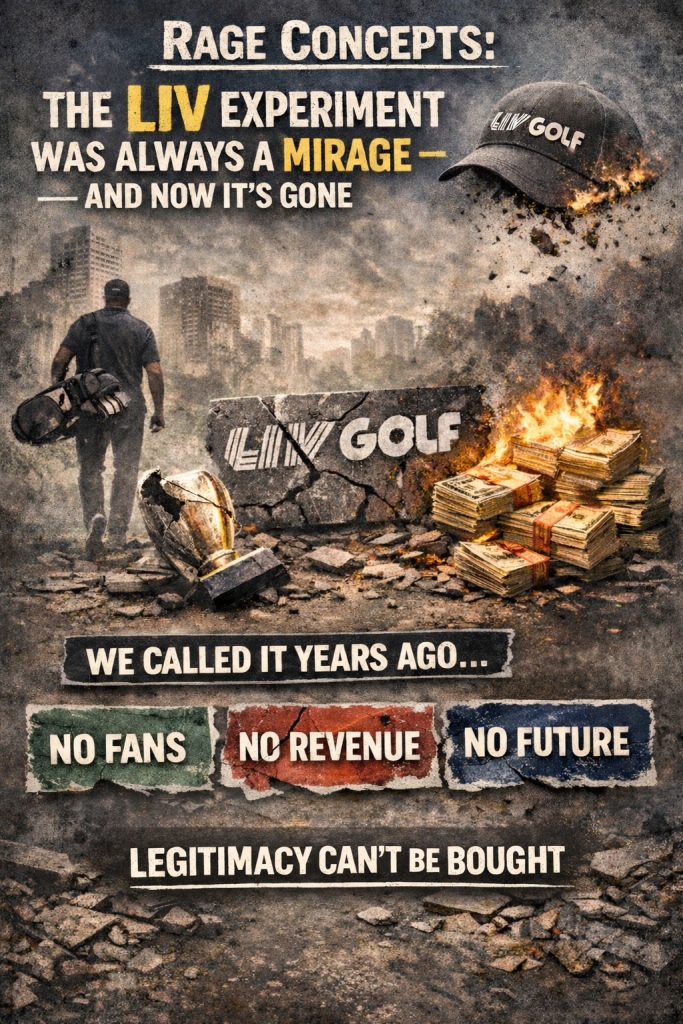
In 2022, when LIV Golf burst onto the scene with blank-check bravado, there was a chorus insisting “this time is different.” Disruption. Innovation. A new model for professional golf.
We said then what should have been obvious: It wasn’t a revolution. It was subsidized chaos.
Now that LIV is on the brink of folding, the postmortems are trying to sound sophisticated. They aren’t. The ending was baked in from the beginning.
It Was Never a Business
From day one, LIV didn’t operate like a league trying to stand on its own. It operated like a marketing arm with a bottomless wallet. Guaranteed contracts, no meaningful revenue pressure, and a format that never quite figured out what it wanted to be either a team sport? individual competition? exhibition? WTF was LIV golf?
The core problem was simple: there was no economic reality.
The PGA Tour, for all its flaws, is tied to sponsors, broadcasters, ticket buyers, and decades of institutional momentum. LIV tried to skip that entire economic ecosystem and replace it with endless capital.
Endless money might buy attention. It can’t manufacture a sports league or a legitimate business model for that matter.
Fans Didn’t Buy In
There was a lot of talk about “growing the game.” What actually happened was LIV Golf fragmented an already fragile game.
Casual fans were confused. Core fans were skeptical. The team concept never landed because it had no history, no identity, and no emotional hook. Golf isn’t Formula 1 or soccer World Cup. You don’t just invent teams and expect tribal or country loyalty to appear overnight.
Even worse, LIV underestimated something basic: people only care where competition matters. Majors still mattered. Legacy still mattered. LIV events felt optional, and in sports, “optional” is fatal.
Players Took the Money and the Signal Was Clear
Critics were told to stop clutching pearls when players jumped. “It’s just business,” we were told.
Exactly. And the players treated it like business not like a competition or mission. They took guaranteed money up front because the long-term viability of LIV Golf was dead in the water at inception. That wasn’t cynicism. That was rational behavior.
When your own talent doesn’t act like the league will exist in ten years, that’s not a branding problem. That’s a structural problem.
The Media Narrative Finally Caught Up
For a while, coverage bent over backward to frame LIV as inevitable. Market or “monopoly” disruption sells headlines. But eventually, the gap between narrative and reality gets too wide and even the bought and paid for media couldn’t maintain writing fiction to stretch that gap.
Low viewership. Murky deals. Constant repositioning. And an ongoing identity crisis.
At some point, you run out of ways to describe a struggling product as “early-stage.”
This Was Predictable
None of this requires hindsight.
A league with:
- no organic fan base,
- no sustainable revenue model,
- no coherent competitive identity, and
- no integration with the existing economic ecosystem
was never going to outlast the novelty phase.
It was a high-cost experiment that confused spending with strategy.
The Real Lesson
The takeaway isn’t “don’t try new things.” It’s more specific than that:
You can’t shortcut legitimacy in sports.
Legitimacy in sports is build it through:
- meaningful competition,
- continuity,
- stakes that people understand, and
- time.
LIV tried to buy all four at once.
That’s not how it works.
We Didn’t Miss This And Neither Should You
At its inception, Rage Concepts LLC predicted LIV Golf would fail. This wasn’t a bold contrarian take. It was a basic read of incentives, structure, and human behavior. The noise was loud. The lack of fundamentals was louder.
And in the end, the fundamentals won and the LIV Golf experiment died.
We’re not happy about it. We could tell at the beginning that this demise was inevitable.