
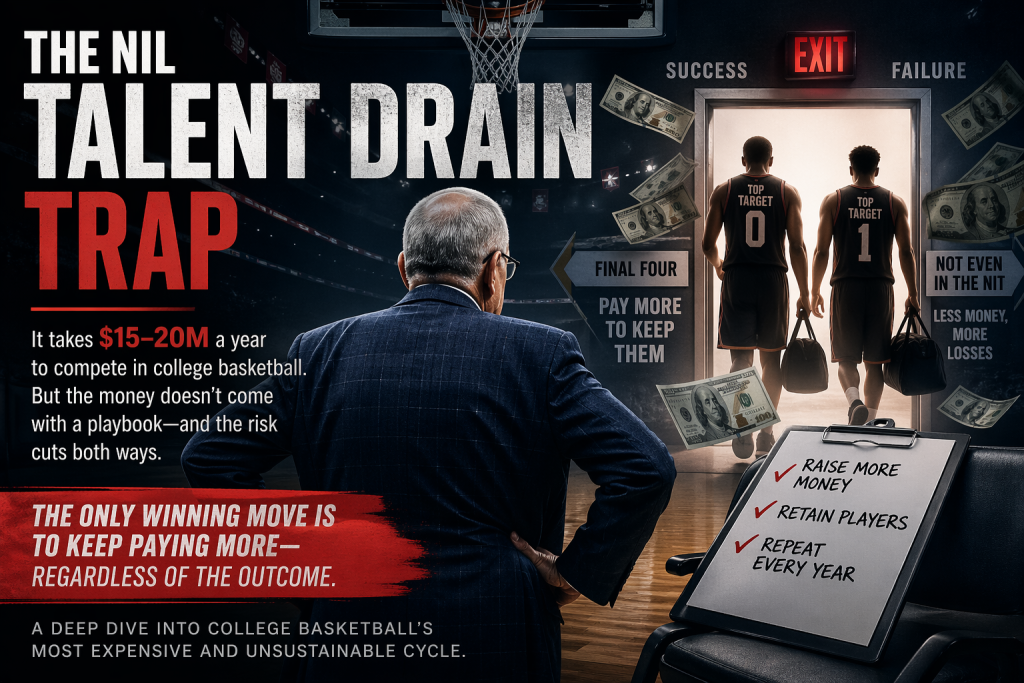
When Jim Boeheim talks about money in college basketball, it carries weight because he has seen the sport before and after the NIL era. His recent comments cut through the noise: Boeheim said that it now takes $15–20 million a year to field a roster that can seriously compete. That number isn’t theoretical. It reflects what insiders across the sport are now quietly acknowledging. Reporting from outlets like ESPN and On3 has reinforced the same trend: high-major programs are operating in the eight-figure range, and anything materially below that will likely result in an uncompetitive team.
From Recruiting to Procurement: The Boeheim Signal
Boeheim’s point wasn’t just about dollars and inflation. It was about what those dollars represent. Programs like Syracuse men’s basketball have reportedly operated closer to the $8 million range, and that gap has real consequences on the players that Cuse can roster. As Boeheim said in interviews, even $10 million “doesn’t guarantee anything,” which aligns with broader reporting across The Athletic and CBS Sports describing NIL as an escalating marketplace rather than a supplemental system. The implications are completely straightforward. Roster building has shifted from development to acquisition with the NIL market dictating the prices and the outcomes.
A System Without Traditional Economics
What makes this environment unusual is that it doesn’t function like a normal sports economy. In professional leagues, spending is at least loosely tied to revenue, whether through media rights, ticket sales, or sponsorships. Here, that connection is totally missing. NIL spending is driven primarily by booster collectives and donor contributions which are not tied to any direct financial return. As analyses in Sports Illustrated have pointed out, the NIL system resembles a form of funding more than a traditional market that has competitive success funded externally rather than being generated internally through donations.
The Misunderstood Constraint: TV Money Isn’t Roster Money
At first glance, it might seem like college sports already generate more than enough revenue to support this level of spending. Conferences like the Big Ten and the SEC distribute tens of millions of dollars annually to member schools through media deals with networks such as ESPN and Fox Sports. In some cases, total conference distributions exceed $70–100 million per school each year.
The problem is that this isn’t basketball money. It’s athletic department revenue. Those funds are spread across football, coaching salaries, facilities, scholarships, travel, and non-revenue sports, like field hockey and volleyball. Basketball must compete internally for funding, and there is no structural requirement that television revenue be directed toward player compensation. At the same time, most NIL funding still exists outside the university system, flowing through collectives and donor groups rather than institutional budgets.
This creates the disconnect. Even as television revenue grows, it does not translate directly into roster spending. Instead, programs are left operating in two parallel economies with one driven by institutional revenue and another driven by external NIL funding. As reporting from Yahoo Sports and HoopsHQ has stated that separation is one of the defining economic disconnects in the current NIL model.
The Missing Feedback Loop
The absence of a revenue feedback loop is the central economic issue to the NIL model. A program committing $15 million to its roster has no realistic way to generate that same amount in incremental revenue. Television contracts are shared at the conference level, ticket pricing has natural limits, and merchandising is only a drop in the bucket. The result is a wide and constant gap between cost and return. This gap must be filled each year by voluntary contributions. That’s no easy feat.
That reliance on external funding introduces uncertainty. Unlike institutional revenue, donor contributions are discretionary and influenced by perception, performance, and engagement. As insiders have noted in coverage by The Athletic and On3, collectives are already navigating the challenge of sustaining year-over-year commitments in an environment with no built-in financial balance.
Echoes of LIV Golf but Without a Backstop
The comparison to LIV Golf continues to surface because the structural similarities can’t be ignored. Both systems rely on aggressive spending to attract talent where long-term economics are uncertain. However, there is a major distinction. LIV Golf operates with one centralized financial backer while college basketball NIL funding relies on decentralized donor networks.
That difference introduces fragility. As discussed in coverage by The Wall Street Journal and Bloomberg, sports funding systems that depend on sustained external funding without a corresponding revenue model often face long-term stability issues. College basketball’s NIL structure increasingly raises those same concerns.
The NIL Talent Drain Trap
Another challenge is the recurring nature of NIL obligations which has created what can best be described as the NIL Talent Drain Trap. NIL costs are not one-time expenditures. They reset every year, often at increasing levels. A program that spends $15 million this season may need to spend even more the next season just to simply maintain its position. But the pressure cuts both ways. When a team is successful, its players become more valuable in the open market forcing the program to raise even more money just to retain them. When a team struggles, donor enthusiasm can fade, reducing the available funding and making it even harder to keep talent in place.
The result is the same in both cases: players head to the portal. Success makes them more expensive, and failure makes them harder to afford. The only winning move is to keep paying more regardless of performance (whether your team is in the Final Four or wasn’t even invited to the NIT). Over time, this creates a continuous outflow of talent draining from your program. Unless funding can keep pace with a rapidly increasing market, there are serious questions about whether this NIL model can be sustained year after year.
What Happens When the System Gets Stressed?
There are already signs that pressure is building. Program performance is increasingly tied to financial capacity, and roster stability is directly influenced by NIL resources. Coaches are operating in an environment where talent retention depends as much on funding as it does on development or culture. At the same time, the broader landscape remains unsettled, with no clear consensus on how the system will evolve or stabilize.
The Final Bigger Question
Boeheim’s $15–20 million estimate ultimately is as a signal of how far the economics of college basketball have shifted. The sport now operates in a space where continued competitiveness requires significant annual funding with no guaranteed return and no integrated revenue structure to support it. Whether that model represents the new status quo or a temporary phase remains uncertain. What is clear is that the current trajectory raises fundamental questions about college sports sustainability in the NIL era and whether a system built on continuous financial escalation can survive for the long term. We question the long-term stability of the general college athletic NIL model as it currently stands.