
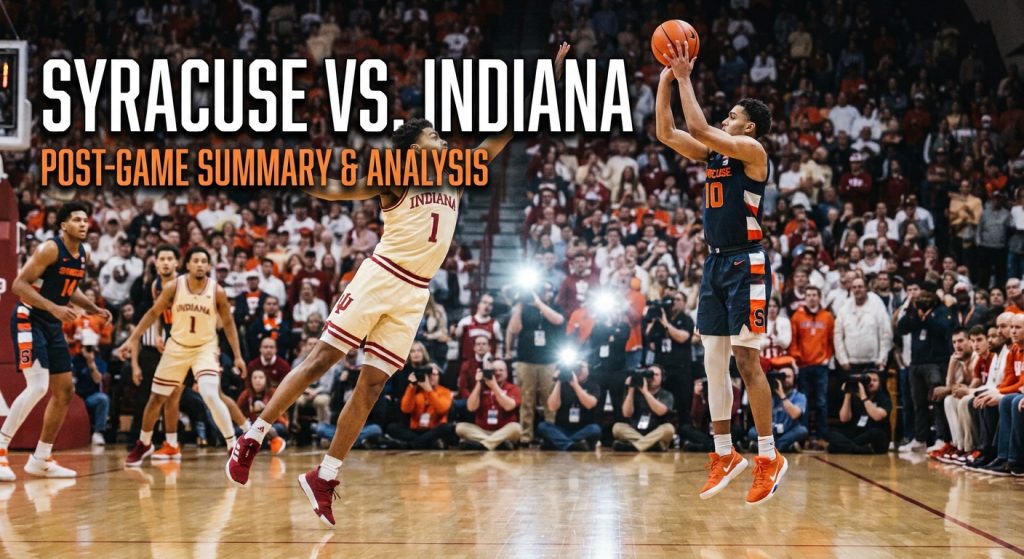
Syracuse had Indiana within reach Monday night. The Orange led 38–34 at halftime, traded punches throughout the second half and held a one point lead with 3:33 remaining. Indiana made the plays, and the free throws, down the stretch to finish with an 83–80 win in Indianapolis.
Syracuse falls to 2–1, but this game gave us a better read on the team than either of its first two wins. The Orange could compete with Indiana. Finishing the job was another matter.
Syracuse shot 50.9% from the field, made eight of its 19 threes and outscored Indiana 32–28 in the paint. Indiana’s size down low was a concern coming in, but it didn’t prevent Syracuse from finding good shots.
Ryan Moesch led the Orange with 19 points and six assists. Kiyan Anthony added 16 points, including a perfect 6 for 6 night at the foul line. Together, they helped Syracuse’s bench outscore Indiana’s 40–11. Sadiq White adde13 points on 6 for 8 shooting, and Luke Wilson scored 11 on just five shots.
That production mattered on a night when Gavin Doty finished with five points and Mark Morano played only eight minutes. Syracuse found scoring elsewhere and stayed in the game.
Before tipoff, we questioned whether the Orange could sustain their effort for a full 40 minutes against a more demanding opponent. Syracuse scored 42 points after halftime and shot 53.6% in the second half. Those numbers don’t answer every question about stamina, but the offense kept producing, and Syracuse was still fighting for the win in the final minutes.
The problems came in other areas.
Indiana won the rebounding battle 37–28 and collected 14 offensive rebounds to Syracuse’s seven. The Hoosiers finished with only a three point advantage in second chance scoring, but those extra possessions gave them more opportunities in a game with little room for error.
Turnovers were especially costly. Syracuse committed 12 to Indiana’s 11, a small difference until you look at what happened afterward. Indiana scored 20 points off turnovers. Syracuse scored eight. Fifteen of Indiana’s points off turnovers came in the second half.
Our pregame case for keeping this close included Syracuse’s ball security. That part of the argument took a hit. The Orange’s shooting and bench production kept them within reach, but Indiana made more of Syracuse’s mistakes.
Then came the foul by Anthony.
With the score tied 74–74 and 1:14 remaining, Anthony was called for a foul on Darren Harris’ three point attempt. Harris made all three free throws, putting Indiana ahead 77–74. Syracuse never tied the game again. For us, that was the late turning point. A tied game became a three point deficit without Indiana having to make a basket.
It was a costly moment in an otherwise productive night for Anthony. Indiana’s foul shooting made those mistakes particularly difficult to overcome. The Hoosiers went 17 for 18 at the line in the second half and finished with six more made free throws than Syracuse.
The Orange still gave themselves one last chance. Trailing by three in the closing seconds, Syracuse forced a turnover and got the ball back. Anthony’s deep three before the buzzer missed, leaving the Orange one shot short of overtime.
Our prediction was Indiana 73, Syracuse 71. The actual margin was three points instead of two. That was a strong result for the margin forecast, although we underestimated Syracuse’s scoring by nine points and Indiana’s by ten. The spread was close, but the scoring total needs more attention in our model.
Our confidence setting stays at −8. With all three results included and the remaining matchup settings unchanged, the model’s most likely season record remains 17–15. Its underlying expected win total has slipped from approximately 17.5 to 16.8, so the outlook has softened slightly even though the headline record hasn’t changed.
The simulator incorporates the final score through its performance adjustment. Rebounds, turnovers and individual minutes help us evaluate the game, but they are not separate inputs in the current calculation.
Next comes No. 13 St. John’s on Sunday at Madison Square Garden. Syracuse showed it could score against Indiana and stay competitive through the final possession. Now it needs to take better care of the ball, finish possessions on the glass and avoid giving away points when the game is there to be won.