
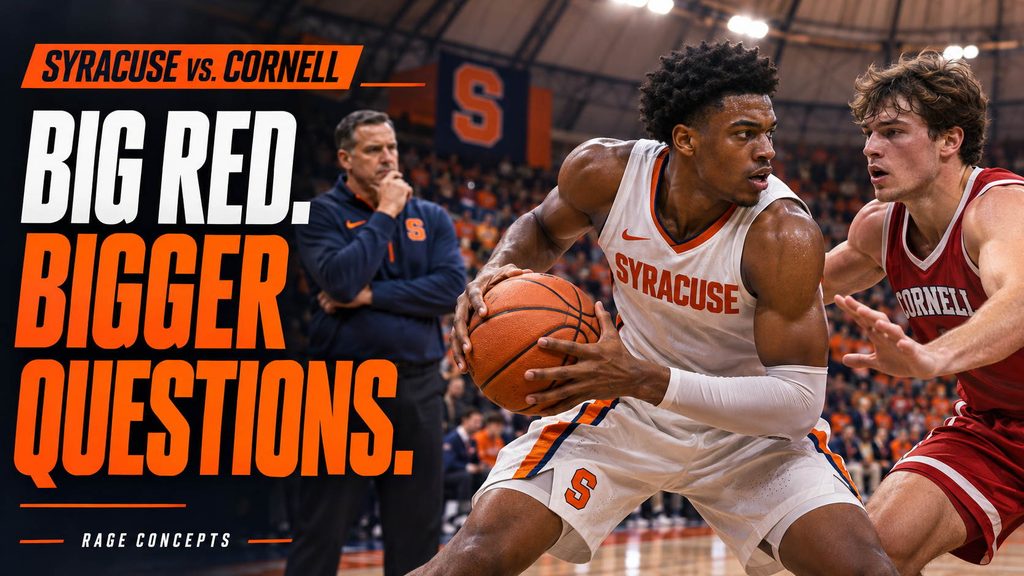
Syracuse should beat Cornell on Wednesday. After what we watched against St. John’s, though, I’m going to be watching the sideline as closely as the scoreboard.
The Orange return to the Dome at 2–2, with another 2–2 team coming in for an 8pm Eastern tip off time. Cornell gives Syracuse an opportunity to get back in the plus win column. It also gives Gerry McNamara a chance to show what he learned from the last two games.
Syracuse led Indiana 38–34 at halftime and St. John’s 33–30. The Indiana game stayed competitive to the final possession. Against St. John’s, the Orange were outscored 49–29 after the break.
Those are different losses, and they deserve different explanations and analyses. The stats and numbers don’t show Syracuse ran out of gas. They do show a team that gave away too many possessions and, against St. John’s, couldn’t make enough shots to recover.
They also leave some fair questions for the coach.
McNamara played Ryan too Moesch.
That was my reaction to the St. John’s game, and the box score gives us plenty of reason to discuss it. Ryan Moesch played 33 minutes, committed nine turnovers and shot 3-for-11, including 1-for-7 from three. Seven of those turnovers came before halftime.
He also grabbed nine rebounds and handed out five assists. The freshman kept competing. But effort doesn’t erase empty possessions, and McNamara had enough evidence before halftime to try shorter stretches or give Garwey Dual more of a role bringing the ball up and getting the offense started.
Dual finished with one turnover in 28 minutes. That doesn’t guarantee a different result if he handles the ball more. It does make that adjustment worth considering when your primary ball handler is having a different kind of night.
The Indiana game is an important part of this discussion, too. Moesch had 19 points, six assists and just one turnover in 26 minutes against the Hoosiers. He helped keep Syracuse in that game. Giving him responsibility afterward made sense. Continuing with the same approach as the St. John’s turnovers piled up is where I question McNamara.
A freshman needs room to learn. His coach also has to recognize when a reset might help him and the team.
There was less bench time against St. John’s, but the bench didn’t disappear. Syracuse’s bench played a combined 80 minutes and scored 40 points against Indiana. Against St. John’s, those numbers dropped to 61 minutes and 29 points.
Part of that change came from Moesch moving into the starting lineup. His production counted as bench scoring against Indiana and starter scoring against St. John’s. Comparing the totals without mentioning that would give the wrong impression.
Kiyan Anthony and Amarri Monroe supplied all 29 bench points against St. John’s. Anthony scored 17, added four assists and committed no turnovers. Monroe scored 12 on 5-for-6 shooting and had three steals. McNamara increased Monroe’s minutes from 12 against Indiana to 22, while Anthony went from 26 to 28. The coach did give those productive players more time.
My concern is how the responsibilities were distributed as the game changed. Anthony was producing without giving the ball away. Monroe was making his opportunities count. Syracuse needed more possessions built around what was working.
Across the two losses, Indiana and St. John’s scored a combined 52 points off Syracuse turnovers. That puts pressure on everybody including the players making the passes, the teammates receiving them and the coach organizing the offense. Cornell shouldn’t get an Orange gift basket of extra possessions.
The Big Red present a different challenge. Cornell takes 51% of its shots from three but makes just 29.6% of them. Syracuse needs to find those shooters, contest the shots and finish the possession with a rebound. The historically low percentage through three games doesn’t mean Cornell will miss the open ones Wednesday.
That sample matters. Cornell’s stats in this comparison cover three games; its 99–59 win over Keuka is excluded. Syracuse’s figures cover all four games. Cornell averages 71.3 points and allows 81.3 in that sample, compared with Syracuse’s 79.5 scored and 67.2 allowed.
The clearest opportunity for Syracuse may come around the basket. Cornell collects only 62.5% of available defensive rebounds and allows 16 second chance points per game. Syracuse should make the Big Red defend inside, then make them work again when the first shot misses.
Syracuse also holds an advantage in effective field goal percentage, which adds accounts for the extra value of threes, Cuse 55.8% to Cornell’s 49.7%. Cornell has played at a quicker pace, but the Orange don’t need to rush into a three point contest to keep up.
I want to see Anthony continue getting good scoring opportunities, Monroe stay involved and Sadiq White and Luke Wilson make Cornell defend under the basket. I also want to see what McNamara does if the offense starts getting careless again. An adjustment while the lead is still manageable beats an explanation after it is gone.
Rage Concepts Model Predictions
Our prediction is Syracuse 83 Cornell 69. Our projected line is Syracuse −14 with a 73.2% chance of an Orange win. The season confidence setting remains −8, and our current most likely finish is 17–15. Our simulator uses this season’s scores and box scores to estimate pace and scoring efficiency, accounting for opponents and game location.
Keeping the confidence setting at −8 reflects our continued caution. The simulator already incorporates the completed games. I want to see Syracuse protect the ball, sustain its execution and respond when an opponent changes the game before raising that separate setting.
Our earlier recorded predictions picked the winner in all four Syracuse games. They also missed the Central Connecticut margin by 38 points. Both belong in the discussion of our accuracy.
Cornell is a game Syracuse should win, and our forecast calls for a comfortable margin. What I want to see is a team that earns that margin through good possessions, and a coach willing to change course when those possessions start going wrong.